
Clinton County Criminal Court Cases
Clinton County Court is the main felony trial court. It sits with Supreme Court at the Government Center, 137 Margaret Street in Plattsburgh. Outside New York City, County Court alone can conduct felony trials, though it also has misdemeanor jurisdiction. Plattsburgh City Court handles city misdemeanors, violations, traffic cases, and the first steps in felony matters. Thirteen Town and Village Justice Courts keep their own local dockets for misdemeanors, violations, traffic matters, and felony arraignments or preliminary work.
The Clinton County District Attorney prosecutes cases across that lower-court network, but each clerk remains custodian of the court file. An appearance ticket may therefore point to a local justice court even when an indicted felony later reaches County Court. The Fourth Judicial District court directory provides current Town and Village contacts. The court named on the ticket or docket is the right first call.
The official Clinton County court page shows the building and court contact details pictured below.
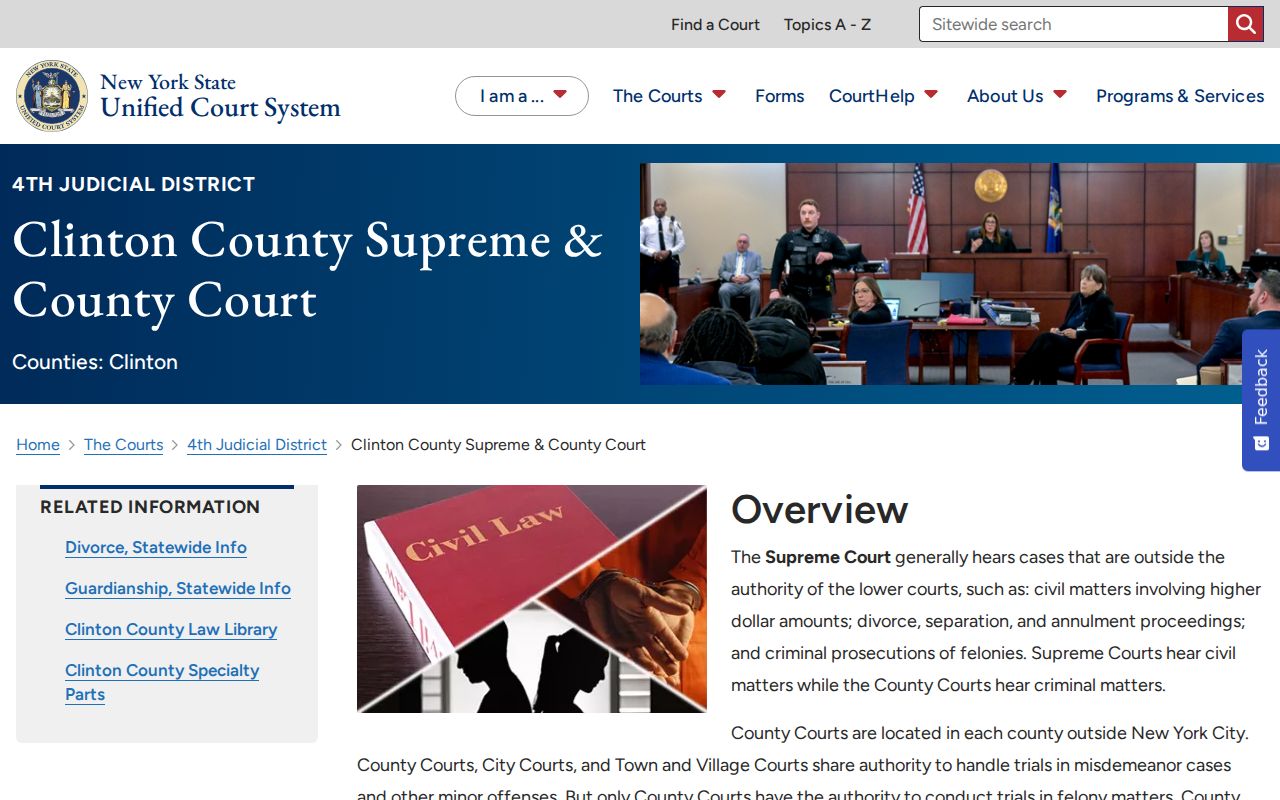
This court page confirms where felony case files are heard and gives the direct route to the County Court clerk.
Clinton County Court or City Court
Court choice reveals where to request the complete criminal case record. County Court holds felony trial and disposition files. Plattsburgh City Court holds its own misdemeanor, violation, and traffic files and handles initial felony proceedings arising in the city. A Town or Village Justice Court may keep the accusatory instrument, arraignment entry, or local disposition for conduct outside the city.
| Court | Criminal role | Contact |
|---|---|---|
| Clinton County Court | Felony trials and dispositions; misdemeanor jurisdiction | 137 Margaret Street, Plattsburgh; 518-536-3840 |
| Plattsburgh City Court | City misdemeanors, violations, traffic, and early felony proceedings | 137 Margaret Street, Plattsburgh; 518-536-3870 |
| Town or Village Justice Court | Local misdemeanors, violations, traffic, and preliminary felony matters | Use the official court directory for the named municipality |
A County Court search alone can miss an open lower-court matter. Likewise, a local docket may stop after an indictment because the felony prosecution has moved to 137 Margaret Street. Follow the case number, defendant name, and court entries instead of assuming one clerk has every stage.
Searching Clinton County Case Records
New York eCourts WebCriminal is the free public starting point for pending criminal-case information and future appearances. It is a docket index, not a download of every filed paper and not a certified criminal history. CAPTCHA or session controls may apply. A name search can produce false matches, while a docket number points more directly to one Clinton County criminal court case.
- Open WebCriminal and choose the defendant-name or case-number route.
- Enter the last name and add the first name or middle initial when useful.
- Select Clinton County and the likely court to narrow broad results.
- Read the court, docket number, status, charges, part, and next appearance together.
- Contact the named clerk for pleadings, sentencing papers, or a certified disposition.
| Field label | Type | Required | Format or use |
|---|---|---|---|
| Search by Defendant | Mode | One mode | Uses the name route |
| Last Name | Text | Yes in name mode | Enter the surname |
| First Name | Text | Portal dependent | Narrows common names |
| Middle Initial | Text | No | One-character narrowing |
| County and Court | Dropdowns | No | Choose Clinton and the likely court |
| Case Number | Text | Yes in number mode | Use the docket exactly as supplied |
| CAPTCHA | Challenge | When shown | Anti-automation check |
Clinton County eCourts Limits
The eCourts gateway links several tools that serve different jobs. WebCriminal is the public defendant and case-status search. eTrack can supplement it with alerts. NYSCEF handles electronic filing and document access where those functions apply, but it does not replace WebCriminal as the general public criminal defendant search.
The official eCourts choices are shown in the source image below.
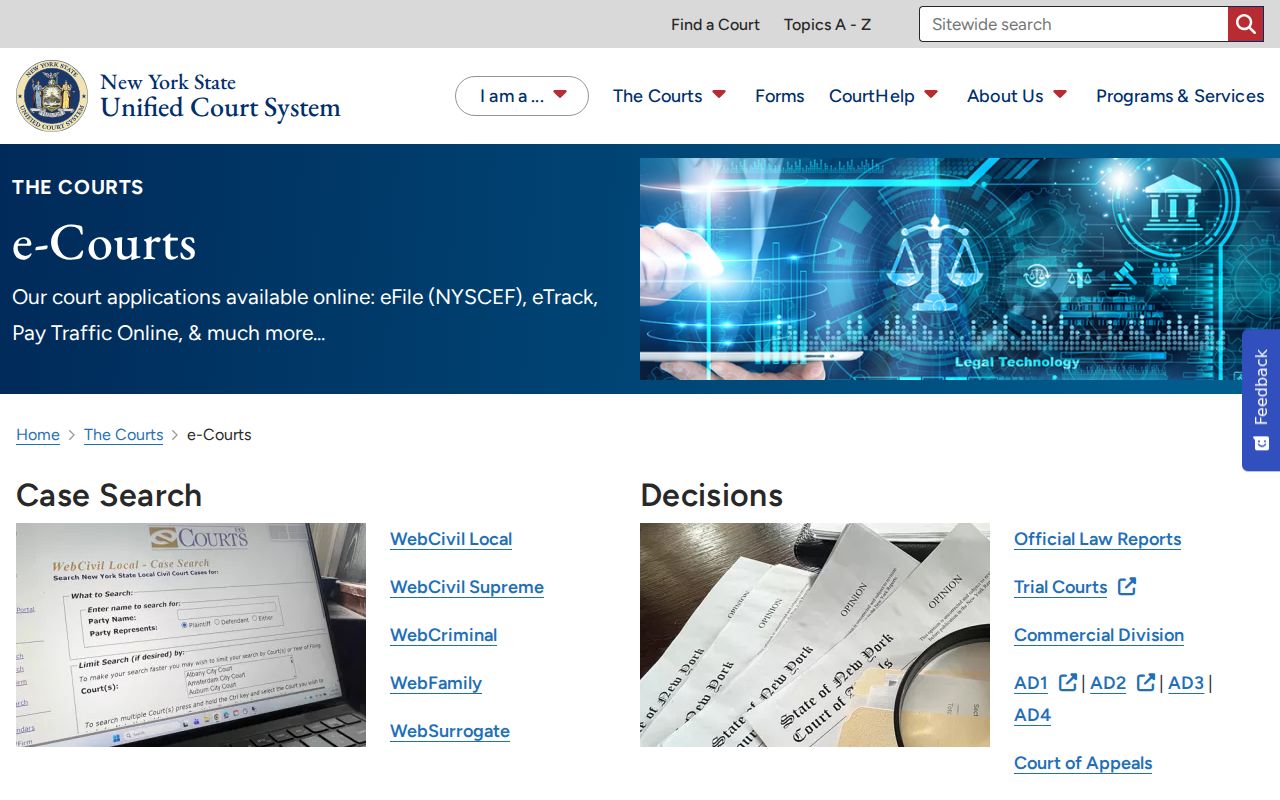
The separate choices explain why an NYSCEF search and a WebCriminal search may not show the same material.
Online results can omit sealed cases, excluded categories, older local data, and papers that the clerk has not made downloadable. Court staff enter the case information, so eCourts technical support cannot correct a wrong disposition. When the result appears incomplete, save the court and docket number, then call the clerk that entered it.
Inside a Clinton County Case File
A Clinton County criminal case file is organized around the prosecution, not the booking. Its docket ties filed counts to court events and the final result. Some entries are only index lines, while the actual accusatory instrument, motion, order, or sentence remains in the clerk’s file. Protected identifiers and confidential filings do not belong in the public view.
| Case number and court | Identifies the docket and the clerk responsible for it. |
|---|---|
| Charging document | Complaint, information, or indictment stating the formal counts. |
| Docket entries | Appearances, adjournments, motions, hearings, orders, and public warrant activity. |
| Charge details | Statute, description, class or severity, count status, and disposition. |
| Appearance details | Date, time, court part, and judge or part information when entered. |
| Disposition and sentence | Plea, verdict, dismissal, acquittal, sentence, and supervision terms when public. |
| Restricted fields | Sealed matters, full identifiers, protected victims, and confidential papers stay out of public display. |
A certificate of disposition is often the most useful proof of an outcome. New York courts list a $5 certificate fee. An in-person request uses photo identification and case details. A mailed request includes the form, a $5 money order payable to Clerk of Court, an identification copy, and a stamped return envelope.
Certified Clinton County Dispositions
The County Clerk assists Supreme and County Courts with filings, fees, fines, and certification. Its public hours are 8:00 a.m. to 4:00 p.m. on weekdays, with no recordings or filings after 3:45 p.m. The office accepts cash, check, and credit card. Its online statement about records from 1972 to the present concerns the document-search service and should not be read as complete online criminal-case coverage.
The Clinton County Clerk page is the source for the office details represented below.
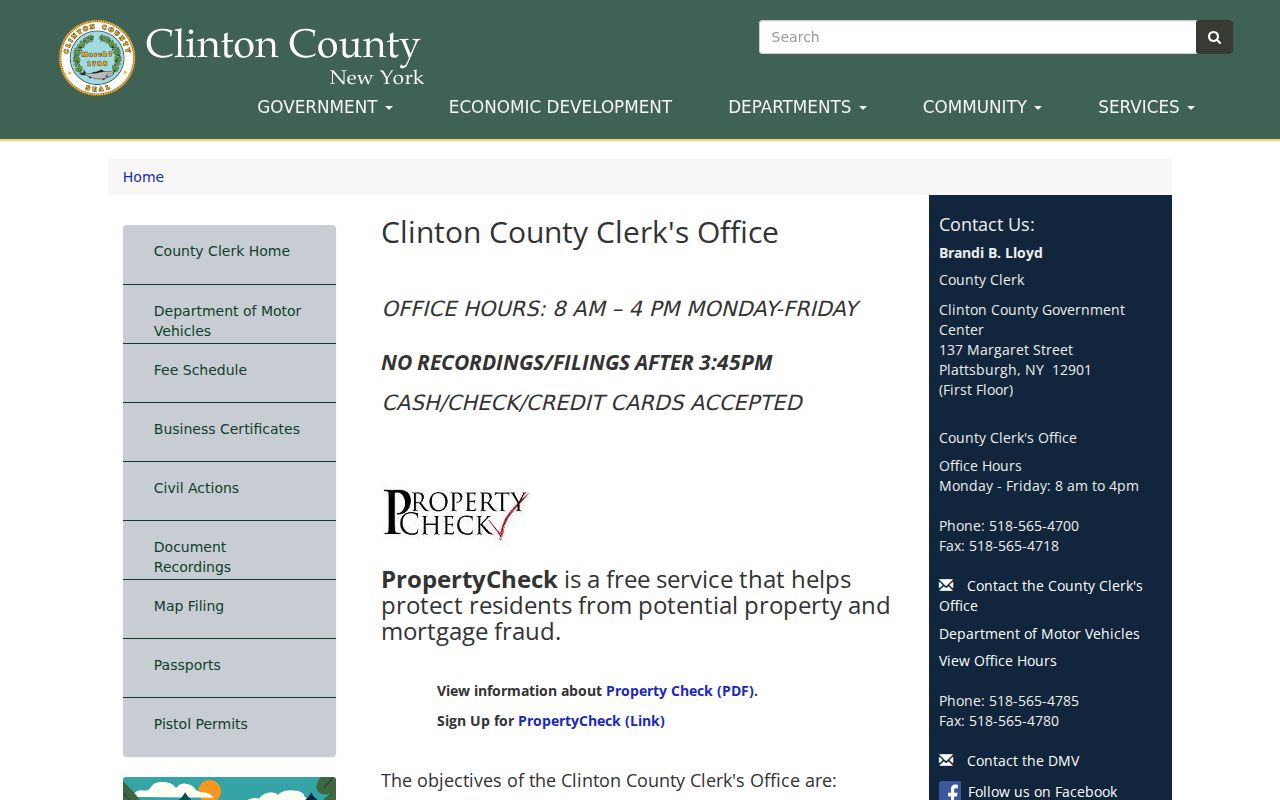
The clerk’s certification role matters when a WebCriminal entry is not enough to show the charge, conviction date, and sentence under court seal.
Two paid court searches fill narrower gaps. The current local criminal-record request costs $5 for each two-year period or partial period searched at a selected court. Each name or date-of-birth variation is a new search. For a statewide exact-name-and-DOB check of public New York court data, OCA Criminal History Record Search charges $95 per combination. OCA CHRS is not fingerprint based, is not a certified disposition, and has historical and legal exclusions. It differs from the subject-only DCJS rap sheet.
Supreme and County Court Clerk
137 Margaret Street
Plattsburgh, NY 12901
518-536-3840
Monday through Friday, 9:00 a.m. to 5:00 p.m.
Clinton County Clerk
137 Margaret Street
Plattsburgh, NY 12901
518-565-4700
Monday through Friday, 8:00 a.m. to 4:00 p.m.
How a Criminal Case Moves
A Clinton County felony may begin in City, Town, or Village Court. After arraignment and preliminary work, a grand-jury indictment places felony trial jurisdiction in County Court. Motions and discovery follow. The case may end by plea or trial, then sentence, and a later appeal may go to the Appellate Division, Third Department. A misdemeanor can remain in the local court that received it.
Case flow: Charges Filed › Arraignment › Pretrial › Plea or Trial › Disposition › Sentencing
Timing depends on custody status and the charge. CPL 180.80 and 170.70 create custody-release consequences when certain accusatory steps are delayed. They do not promise that every Clinton County case reaches each stage in a fixed number of hours.
Reading Clinton County Docket Terms
A few New York terms help turn a docket line into a clear account of the case. Read them at the count level because one charge may be dismissed while another produces a conviction. The displayed arrest charge may also differ from the charge the prosecutor files.
- Accusatory instrument
- The complaint, information, or indictment that formally alleges an offense.
- Arraignment
- The appearance where the court states charges and rights and may address plea or release.
- Disposition
- The outcome of a charge or case, such as conviction, dismissal, or acquittal.
- Part
- The courtroom or judicial assignment shown on a New York docket.
- ACD
- An adjournment in contemplation of dismissal that can later mature into dismissal and sealing.
Note: A docket status is not a certified disposition; obtain the sealed certificate from the clerk when formal proof is needed.
Thirteen Local Clinton Criminal Courts
The District Attorney’s work across Plattsburgh City Court and 13 Town and Village Courts makes Clinton County’s case map unusually decentralized. A sheriff arrest, State Police arrest, campus arrest, or city arrest may all produce a local arraignment record. The case’s next destination depends on the filed charge and whether a felony is indicted.
Drug Court and Mental Health Court assignments are part of the local prosecution system, but specialty treatment does not create a separate public criminal-history portal. Search the underlying court docket. Then ask the relevant Clinton County clerk which program-related orders are public and which treatment details are restricted.
Clinton County Jail creates the booking record, while the Clinton County Sheriff’s Office keeps the deputy report when its staff made the arrest. Neither record replaces the clerk’s criminal case file. If a court case began with a recent booking, the Clinton County arrest lookup explains how the sheriff, jail, and arresting agency records differ from the later court file.
Case Record Access & Restrictions
Judiciary Law §255 directs clerks to search and certify records in their custody, subject to lawful limits. Court-file access is distinct from an executive-agency request under New York’s Freedom of Information Law. Ask the court clerk for judicial records. Use FOIL for existing police or sheriff records created outside the court.
Judiciary Law §255 governs clerk searches and certifications. CPL 160.50 generally seals favorable terminations, while CPL 160.59 permits applications to seal certain convictions.
Sealed cases, youthful-offender matters, full dates of birth, Social Security numbers, protected victim information, and confidential filings are not public. A no-result screen can reflect those legal limits or a gap in older local data. It is not proof that no case ever existed. Contact the named clerk if the Clinton County case should be public but does not appear, and provide the approximate year and docket number if known.